
Ion implantation is a key process in the semiconductor industry but can be impacted by various factors. The article suggests using in-line Secondary Ion Mass Spectroscopy (SIMS) to improve implant process control and meet demand for consistent implantation materials by measuring peak concentration, peak depth, and dose simultaneously.
Abstract
In the semiconductor industry, ion implantation process has expanded to a wide range of applications with doses and energies spanning several orders of magnitude.
Ion implantation is a very complicated process with many parameters and factors that affect the implant profile.
For example, shadowing effects from higher aspect ratio of photoresist opening, ion channeling or de-channeling effects due to implant angle variations, and dose and implant energy accuracies are all important factors in achieving uniform device performance and good product
yield. In addition, current process controls are done on test wafers with certain time intervals, where broken sample pieces are sent outside of the fab for SIMS analysis.
The turnaround time is generally long, and the results often do not reflect the actual production conditions. It is known in some cases that, while the control charts are in good standing, the product has failed to meet its specification.
The demand for consistent implantation material is becoming more and more important. Hence, the desire for better implant process control is sorely needed.
This article explores how utilizing Secondary Ion Mass Spectroscopy, (SIMS) in-line to measure peak concentration, peak depth, and dose simultaneously to provide better implant process control.
Background and Introduction
The implantation of ions, mainly Boron, Phosphorous, and Arsenic, have a long history of use in semiconductor manufacturing. By implanting ionized atoms into a semiconductor material n-wells or p-wells can be created, changing the conductivity of the material, a technique that is often used to control threshold voltages of MOSFET devices. The creation of p-n junctions via ion implantation can prevent current flow to the substrate. Alternatively, ion implantation can create contacts to lower contact resistance and prevent diode formation. In the semiconductor industry, ion implantation process has expanded to a wide range of applications, as shown in Figure 1, with doses and energies spanning several orders of magnitude. Depending on the device, a large number of implant operations may be required in the manufacturing process flow.
Figure 1. Ion implantation applications in silicon technology at various doses and implant energies1
After implantation, the concentration distribution of the implanted ions within the material will resemble a Pearson IV distribution, with the peak depth being controlled by the implantation energy and the concentration being controlled by the implantation dose. Due to the Pearson IV distribution of the implanted ions, the only metrology method capable of measuring the peak concentration, peak depth, and dose simultaneously is Secondary Ion Mass Spectroscopy, or SIMS. By sputtering down through a material, a depth profile of the implanted atoms can be measured, giving a complete look of the shape, amplitude, and depth of the implanted ion distribution.
Figure 2 shows the distribution of implanted Boron in Silicon using a TRIM/SRIM Monte Carlo simulation.
Figure 2. Using TRIM/SRIM, (a) Monte Carlo simulation of ion implantation, and (b) Distribution of implanted Boron atoms in Silicon.
Ion Implant Metrology Challenges
Ion implantation is a very complicated process with many parameters and factors that affect the implant profile. For example, shadowing effects from higher aspect ratio of photoresist opening, ion channeling or de-channeling effects
due to implant angle variations, and dose and implant energy accuracies are all important factors in achieving uniform device performance and good product yield. In addition,current process controls are done on test wafers with certain
time intervals, where broken sample pieces are sent outside of the fab for SIMS analysis. The turnaround time is generally long, and the results often do not reflect the actual production conditions. It is known in some cases that, while the control charts are in good standing, the product has failed to meet its specification. The demand for consistent implantation material is becoming more and more important. Hence, the desire for better implant process control is sorely needed.
Metrion®
Nova’s Metrion® is a 300mm wafer-level in-line SIMS metrology system developed to seamlessly integrate with an automated high-volume manufacturing (HVM) fab environment.
It is a fully automated recipe driven metrology tool utilizing a Magnetic Sector mass analyzer to provide high quality dynamic SIMS depth profiles. It has an O2 ion source that ranges from low to medium high in beam energy for a variety of applications. Because Metrion® utilizes a low voltage secondary ion extraction field, it enables stable and repeatable measurements within a 50um x 50um metrology pad on product wafers. With multiple parallel detectors, Metrion® can measure multiple species simultaneously through the entire film stack, providing high data density capable of achieving higher depth resolution.
Process automation with built-in film analysis and recipe management make the system easy to use and shorten the time to data.
B-implant Application
Boron is one of the most commonly implanted species in semiconductors. It has one fewer valence electron than Silicon, which upon implant, results in a p-type semiconductor. As shown in Fig 1, Boron implant is used in a wide range of applications, in all types of devices in both logic and memory space.
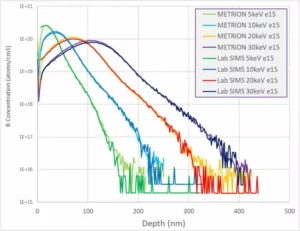
Figure 3. Metrion® vs Lab SIMS results for 1e+15 Dose B Implant in Si wafers with Implant Energies of 5, 10, 20, and 30keV.
Figure 3 compares various B-implant SIMS profiles between Metrion® and lab equipment. As can be seen, the Boron concentration vs depth profiles from Metrion® matches very well with results from lab SIMS. With a full wafer measurement capability, wafer maps can easily be generated from measurements of multiple locations on the wafers, enabling within wafer uniformity process control charts.
Figure 4 shows a wafer map example of the Boron peak concentration variation across the wafer, for the 10keV implanted B sample.
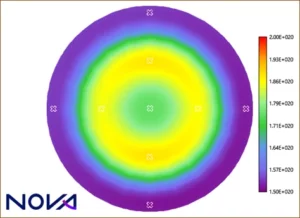
Figure 4. Wafer map of B peak concentration, 10keV Implant
As a HVM metrology tool, precision of the measurement is an important metric. In Figure 5, five profiles, which were measured at locations adjacent to each other as proxy for repeatability testing, are overlayed. As can be seen, all the profiles match very well with each other, demonstrating the stability of Metrion® SIMS measurements. For most implant dopants, a relative standard deviation (RSD) of <2% can typically be achieved.
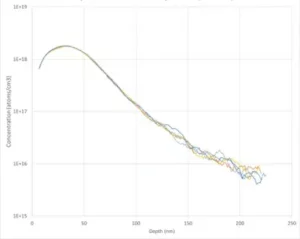
Figure 5. Overlayed of 5x repeat B-implant profiles
Summary
Nova’s Metrion® system is an innovative SIMS platform designed for the Fab environment, seamlessly integrating into an automated factory workflow. The system is engineered to deliver wafer-based high precision metrology results for process control in logic and memory devices, as demonstrated on ion implant applications. This is enabling Statistical Process Control (SPC) of the ion implant process parameters and providing in-line data correlating to electrical performance.
Authors: Benjamin Hickey, Wei Ti Li, Sarah Okada, Lawrence Rooney, Feng Zhang
First published at SIMS 23
Tell me a little about yourself.
I’m married to Peli who is a SW developer at applied materials, which means we both work in the Semi industry ????. Together we have 3 amazing girls: Yuli, Emily, and Yuval, and a Cat, Joy. I live in Beit Hashmonay and studied Management and Logistics.
What do you do at Nova and how long have you been working here?
I’ve been working for Nova for 9 years as a senior strategic buyer responsible for Electro-Optics Commodity, EFEM (FI) & Computing.
I started out as a Strategic Buyer for Computing and Electronics and over the years, my career evolved, and I became a senior buyer, and my account was focused on strategic TK. Later on, I took the role of leading the RMA cycle across the Procurement team. I really enjoy exploring the processes and optimizing them as best as possible.
From your professional experience, what makes you choose Nova every day?
I have two main reasons:
First and foremost: the people working at Nova.
I go to work every day feeling that the colleagues I work with are also my personal friends and I would almost say they are like a family.
And the second thing that makes me feel great working here is the professional challenges I am dealing with. In my position in the procurement department, Nova allows me to take responsibility for a vast array of commodities, to work with various position holders from CTO/R&D to the Production level. I’m constantly motivated to learn about new technologies, explore additional technical needs, and research so that I provide the best solutions for my counterparts at Nova.
This allows me to develop optimal procurement agreements for the organization and make the best when I manage the day-to-day activities and relationships with the suppliers to assure positive partnerships in the long run.
We all know that the procurement department has an exceptionally unique friendly atmosphere- care to share a little about this?
That is such an accurate description! The procurement team is my happy place! They are not just my colleagues or team members, they are my friends! I feel confident consulting with them and sharing my personal experiences. I know that I will always be accepted for who I am no matter what. We do have a unique team with a friendly and supportive atmosphere.
I wouldn’t exaggerate by stating that at Nova I made my closest friends. The women that I talk to on a daily basis, share professional as well as personal experiences and life events, we spend our weekends together and even traveled abroad for vacation. Even our husbands became good friends, and they have their own WhatsApp group, which is mostly used to complain about us ????
That sounds awesome.
You often travel for business- what does a typical business trip look like for you?
A typical business trip feels as though someone put my life on fast forward. There are so many things happening!
Many long-distance flights, long working days full of meetings, production reviews, and technical discussions alongside quality reviews. There is also some time for fun with dinner meetings or strolling around the cities I visit.
And then, in the morning back to the meetings. Sometimes it repeats on the following day or on my next business trip to a different location on the Globe.
One thing that always happens during these trips is that I miss my family very much. I am fortunate to have an amazingly supportive husband that helps me pursue my professional passion.
What do you enjoy doing in your spare time?
I am a huge fan of sports and in my spare time, I enjoy playing Catch ball. Basically, if I’m not at home or at work I’m on the court.
Along with my friend and colleague from the procurement department, Efrat Arad, we initiated a women’s catch ball team here at Nova. This has been a long-time dream of mine, and now, with the support of Nova’s well-being team, this is actually happening and we already have a dozen great players getting together once a week for practice. This is really a dream come true.
This is really inspiring to see how you made your dream come true.
Where do you see yourself in 5 years?
I hope to be happy and evolve my career in a way that challenges me to succeed and excel.
Let’s finalize with a question many want to ask, but never dared: What is your superpower?
I jump really really high ????
Well, that sounds very useful for someone who plays catch ball and is as ambitious and energetic as you are
Gila has been with Nova as early as 1/1994, almost since the beginning. As Nova's most veteran employee, Gila is trusted by others for her vast institutional knowledge and memories of how things were founded and evolved.
Through the changes over the past 30 years, Gila is proud to say that one of the company’s strongest founding values are creativity, accountability, motivation, and commitment.
Gila, tell us a little about yourself
I joined Nova after my maternity leave, with my twins, Tomer and Maya. Before then, I worked in the Israeli Embassy in Washington DC while studying behavioral science at the University of Maryland. Ten years ago, I studied logistics at Bar Ilan University. For the last 20 years I’m in a relationship with Yair and my hobbies are Bridge and sports, yet, when it comes to sports, I mostly enjoy watching them… not so much doing…).
What are you doing at Nova today?
When I started working at Nova, I was the seventh employee. Currently, nearly 30 years later, I am the logistics manager at Nova, responsible for the company’s import and export activities and Nova’s warehouses worldwide. Since joining Nova almost 30 years ago, I have held several positions in different departments. In the beginning, I did most of the administrative tasks, purchasing, travels, import/export, responsible for the leasehold improvements in the various locations Nova moved to and from during the growth periods (from building #1 and adding a lab in building #3, then moving into building #18 and then the whole building #22. As the company grew, I focused on import/export and then received additional responsibility for the global warehouses.
What is your first memory of Nova?
I’ve been at Nova so long that choosing just one memory is difficult, but the first memory that comes into my mind, was when we received our first two purchase orders, at almost the same time for multiple systems from very significant companies in the semi-industry. It was a sense of a dream come true. I can’t explain the enthusiasm and the emotions that followed.
Another memory is when a delegation from a very significant customer came to visit us at the office. The delegation on behalf of the customer was twice the size of Nova at the time! I remember looking at the delegation representatives and counting them one by one. I was sitting at the entrance, and a constant stream of people with suits kept coming in. It was amazing.
In general, I remember vividly that Nova’s innovative and unique solutions together with excellent customer support were the foundations for the success of the first 2-3 years.
Very exciting. So, what has motivated you to continue 30 years in the company?
I have held quite a few positions, and different office locations yet the most impressive office is the one that we moved into 3 years ago.
It is unique in the hi-tech industry to work for such a long time, you need self-motivation and invest a lot of personal effort to keep up with the pace of changes while keeping a high level of professionalism and hard work– “Never Ever Give Up” was the motto of the company from the beginning and I adhered to it all these years!
When I look back, I see that I accomplished different things in different places. The company grew, more people joined the team, and there have always been challenges that added to the interest.
I truly believe that facing our fears, taking responsibility, and demonstrating determination are the key to success for many years.
What has changed in Nova over the years you have been here?
In the beginning, there was more intimacy since we were such a small group. Each one of us knew everything about everything. We were exposed to everything: every purchase, every challenge, every agreement, and also every failure. I can say that there are Nova’s systems from those early days that still work at our customers’ sites.
What hasn’t changed and has been a foundational part of Nova’s corporate culture from the beginning is the tagline of passion, innovation, and performance. I think these things have remained at Nova and are a significant part of our values even today. Another thing that still exists today that has been a defining characteristic of Nova since the beginning are the special, creative, and highly motivated people. The unique organizational culture that was built in the first years continues. I hear this from new employees all the time- that they feel the same positive vibe as it was from the beginning.
It’s a bit of a cliché to say that Nova is my second family.
That’s amazing! What do you wish for Nova in the next 30 years?
That we continue to focus on innovation and technological leadership. I also hope the organizational culture and atmosphere remain as they have been and still are now and that we continue to dream and conquer new heights.
Meet Shira Elnekave, an automation development specialist at Nova, a new mom – and an orthodox Jew. We sat down for a chat about her experience and insights, and how she believes more Orthodox women can find their place in today’s high-tech work environments.
Hi, Shira. Let’s start by sharing a little bit about yourself.
I’m 23 years old, married, and have a toddler son named Uriel. I’ve been working in high-tech for three years now.
I studied program engineering for two years in a seminar called “Elisheva Girls” in Jerusalem.
In my previous position, I worked as a developer. Here at Nova, I transferred to automation development, and I’ve been here since December 2021. I am an Orthodox Jew and live in a warm community of like-minded people in Rehovot.
So, what are the differences between development and automation development?
Standard development involves coding the products sold by the company. However, automation development concentrates on developing the tools or assisting programs that support the product development process.
Those tools help the developer check the code’s correctness and ensure the product is functional in all its developed versions.
We, the automation developers, are running a massive number of tests, allowing us to test our product every day, according to the updated version.
What made you decide to work at Nova?
Before coming to Nova, I worked in Tel Aviv at a company that creates personalized projects for its clients. Despite the interest and the challenge, I wanted to join a more global and stable company that would encourage personal growth. During my first interview with Nova, I was pleasantly surprised to hear, “In two years, if you’d like to change your position or evolve into a new place or study a different technology, we love that, and we are open to it.” That was one of the things that drew me in. The opportunity for personal and professional development, and of course, the fact that it is a large stable company, gave me a feeling of safety. I live in Rehovot, and Nova is also very close to home for me, especially considering that there aren’t many opportunities south of Tel Aviv.
As an Orthodox religious woman, what were the things that supported your integration process?
First of all, my colleagues’ respectful behavior was helpful. In my opinion, this comes from the top down, beginning with the management. Everyone here is encouraged to show ultimate respect and support each other’s personal and professional self-actualization.
From an aesthetic point of view, the offices are gorgeous, which has been a huge benefit for me. It’s fun to work in a beautiful environment.
And there is also my personal point of view, as an Ultra-Orthodox Jewish woman: this was part of the discussion from the start, already in the first interview. They asked me to state my needs and requirements and adjusted themselves accordingly. This was astonishing and exceeded the standards of any other company I worked for. My team manager always suggests arranging one-on-one meetings with an open door, and everyone shows respect, sensitivity, and consideration of my values and religious needs.
In my opinion, everything is well-balanced here. My values and religion take priority, and Nova ultimately respects this and supports me. I asked to be seated in a certain location, and they approved it. In addition, as a new mother, I asked to leave an hour earlier every day, and it was also approved. I feel respected and appreciated, so it is very satisfying.
How is your unique background expressed in the professional aspect?
In the professional aspect, I believe I’m not different in any way from anyone. I am doing my best to be professional, just like any other team member. Thanks to the sensitivity and care for my needs, I give 100% of myself at work with the maximum professionalism, dignity, and respect to the place that treats me in such a way.
If you’d advise your friends, colleagues, or other people to join the Nova team, what would you tell them?
First of all, I’d tell them I work here, so that’s an excellent reason for them to join (laughing). Jokes aside, I’d say to them that working at Nova gives you a sense of joy and positivity at work–which is essential, as we all know. And despite the stress and deadlines, the employee always comes first–their needs are the first priority. In my perspective, this is a distinguishing value and has led to my acceptance in the workplace.
In addition, I’d tell them about the remarkable technologies and the high level of business and tech expertise.
What are the challenges that Orthodox women are dealing with in a technological work environment? And how is it possible to deal with such challenges?
The Orthodox woman is very modest and needs to be able to set her limits when sharing a workspace with men. Communication with men at work should be mostly business related, respectful, and clear of personal talk. An Orthodox woman wouldn’t sit in a closed room with men, but here at Nova, everything is open space, so this matter isn’t an issue.
In Orthodox houses with multiple kids, there needs to be a flexible work schedule. This, too, is addressed here because at Nova, the work is hybrid and allows flexibility in the working hours, too.
In the community you’re coming from, are there some cases where you feel judged about the fact that you’re an Orthodox woman who works in the technology industry?
In my own community, as well as among the general population, the fact that I am a working Orthodox woman is completely natural. It has been quite a common phenomenon for young Orthodox girls and women to study technology and integrate in the biggest technology companies. I have friends who work at Google, Microsoft, and more. Even though in the past it was considered deviant, nowadays, it is natural and acceptable.
What do you think is the key to this massive successful integration of Orthodox women in technology work environments?
I think that what makes it possible is the will and need of Orthodox women for professional development and self-realization, along with being able to contribute financially. Also, a certain open-mindedness has been developed both within religious institutions and high-tech companies themselves. It creates opportunities to integrate different communities that were not previously included in high-tech companies.
Amazing! How do you see the future of Orthodox women in the technology market and other markets?
I believe that the future is already here. All my female colleagues from my studies are working in great companies these days, and this phenomenon is only widening and evolving. My assessment is that this will continue to trend in that same direction, and Orthodox women will be promoted to senior and key positions. They have all the qualifications and skills for that to happen.
Last question, if you’ll allow it: Would you wish for your children to also follow your same path?
Certainly. I will encourage them to do so, to take their talents and desires and invest in them. I won’t promote high-tech if it doesn’t interest them, but I’ll absolutely encourage them to pursue the professional paths they’re passionate about. However, I would be pleased if they chose high-tech because it is my domain and I love it very much.